VLAS is a governing standard that defines the conditions under which a verified improvement in a living system — measured across the Five Capitals and governed by community consent — may be recognized as a finance-grade asset.
Not invented from scratch. VLAS synthesizes what three decades of standards and regulation already proved viable.
A standard is calm and above the market it governs. It does not sell, trade, or list. It defines what counts — and makes that definition auditable. VLAS makes three claims you can re-perform: recognition, verification, and lifecycle.
See how a credit is made →Those are implementations. The standard governs them.
No badge for stated intent. Recognition is earned through evidence.
It does not reduce living systems to tonnes of CO₂.
It produces verified data; professionals decide treatment under law.
The architectures before VLAS could not bear the weight of finance-grade recognition. Each failure has a name — and a fix built into the standard.
Everything collapsed to carbon. Co-benefits invisible.
The claimant picked the verifier. No re-performance.
Buyers couldn’t route capital to what they meant to fund.
A 2018 snapshot treated like active care in 2026.
Consent as a checkbox, never a number in the math.
Integrity was signalled, not manufactured. VLAS inverts the posture — the standard itself manufactures the quality, so a credit cannot exist unless the integrity is real.
Keep them distinct. Most confusion comes from collapsing the standard, the system, and the trust into one thing.
Defines the recognition criteria. The rule set.
The first conformant implementation that runs the pipeline.
The verified living asset — the issued instrument.
The fiduciary container that holds and governs assets.
“VLAS is the law. RCCS is the courthouse. The Registry is the front door.”
Every credit quantity is the product of six terms — and each term is a fiduciary control. If improvement, durability, governance, or certainty is missing, the result is zero. No credit is recognized.
Verified change from baseline, net of leakage and buffers. Only real improvement is priced.
Time in the math. Rewards continuous care over a one-off snapshot.
Ecological durability × legal covenant length. Durability locked into the unit.
Governance quality and FPIC. Consent and shared benefit, encoded.
Scientific and audit conservatism. Prudence enforced.
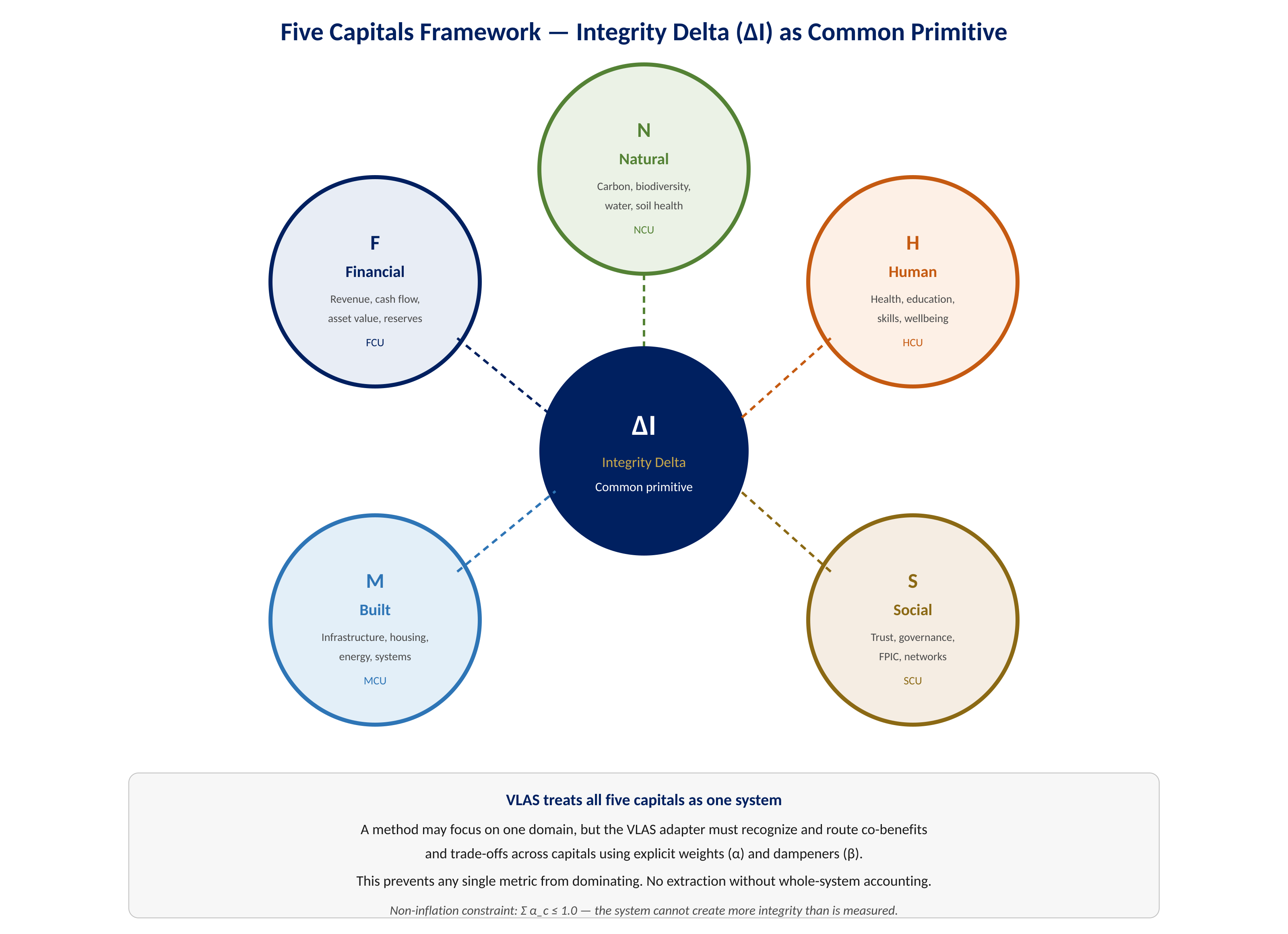
Every verified change is expressed as one integrity primitive — ΔI — then routed across five capitals. A non-inflation constraint means the system can never create more integrity than was measured.
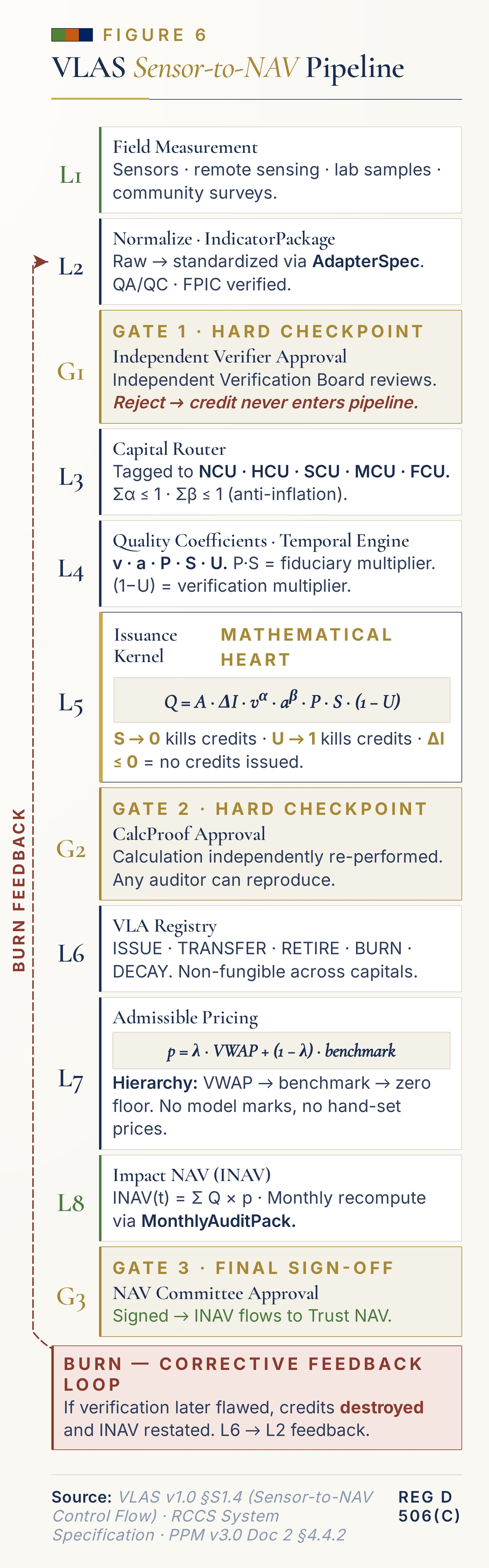
Field data becomes a recognized asset through a pipeline any auditor can re-perform — gated by independent humans, never hand-edited.
An independent verifier approves the measurement package — or it never enters the pipeline.
A different approver signs the calculation. Any auditor can reproduce it from artifacts alone.
The period-end audit pack is approved before INAV flows to trust-level reporting.
A perfect kernel can be undone at the lot — the unit that actually gets priced. So VLAS makes lot formation a structural control: six mandatory axes, five prohibited practices, enforced at the registry.
Prohibited: quality laundering · governance washing · vintage laundering · geographic obfuscation · permanence inflation.

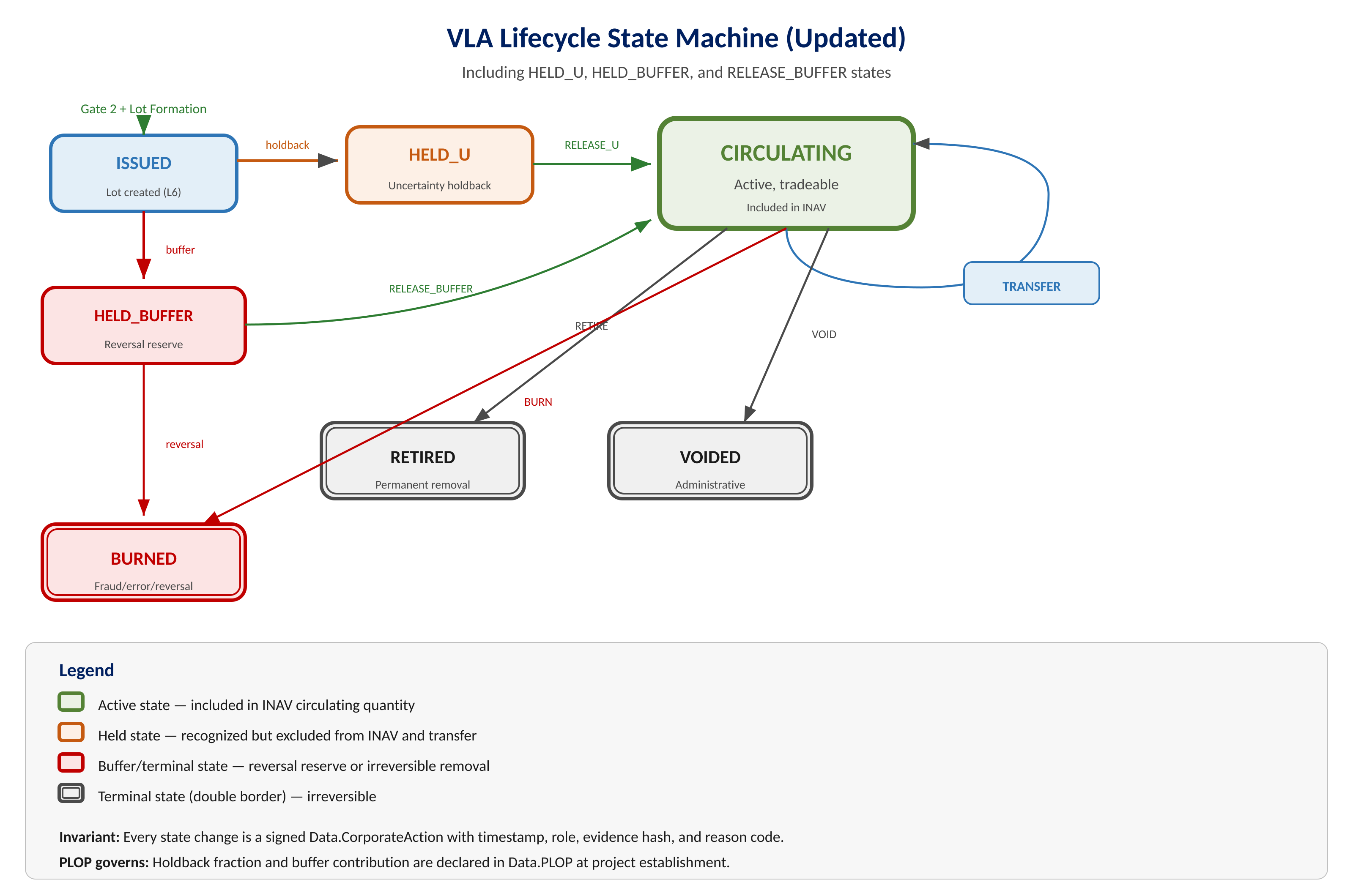
Correctable by design. Every state change is a signed corporate action. If a credit is later found invalid, it is burned and historical INAV is restated. The registry tells the truth over time.
The rule set is one thing. What you lead with depends on who is reading.
Re-performability, conservative pricing, dual NAV / INAV, and capital-class routing — verified upside you can actually own.
The gates, the kernel as fiduciary controls, lot-formation anti-greenwashing, and the lineage from ISO to CRCF.
Community-first lots, FPIC as a gate, stewardship rewarded over time, and a covenanted seat with a share in surplus.
One-way exports to CSRD, TNFD, CRCF and SEEA. VLAS feeds your framework — it never tries to replace it.
VLAS sits upstream of disclosure and certification regimes, exporting verified data through one-way adapters.
A TNFD-compliant organization can hold VLAs; a VLAS issuer can export to TNFD. Interoperable by design — never competitive.
The standard is maintained as a regenerative commons by Regenerative Development Corporation, with custody passing to the VLAS Trust — an independent standards body, constitution pending.
See a real place rendered through it, then decide whether to reference, adopt, or build on the standard.